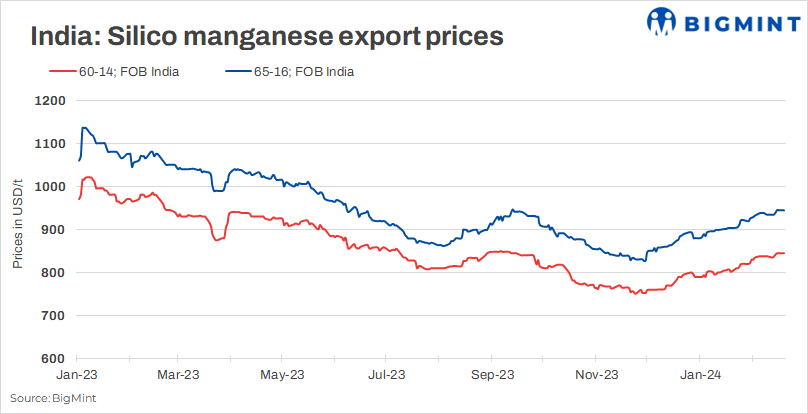
- Export inquiry upliftment leads to price rise
- Chinese market quotes unchanged prices for silico manganese post-Lunar holidays
Silico manganese prices saw an uptick this week, attributed to increased demand from south east Asia, Egypt, Turkey and Japan.
According to SteelMint’s assessments on 19 February 2024, the 60-14 grade was assessed at $845/t FOB, up by $8/t, and the 65-16 grade was rated at $945/t FOB, up by $10/t.
Weekly confirmed deal

Global market this week
Active buying from overseas market: Demand from Japan, Italy, UAE, Egypt and especially from Turkiye witnessed an upswing. “One of the leading exporters from Vishakhapatnam stated, “I foresee a potential $10/t FOB price increase, followed by a period of price stabilization. Currently, there’s an uptick in prices due to increased bulk orders from Turkiye, the Middle East, Romania, and Taiwan.”
Chinese market offerings remain steady: The Chinese silico manganese market exhibited moderate activity following the Spring Festival holiday, reflecting a cautious post-holiday environment. Trading sentiment remained average as factories gradually resumed operations after the holiday break. The market adopted a wait-and-see approach, awaiting further clarity on demand trends. Prices were at around RMB 6,310/t to 6,410/t ($877/t-891/t). All prices were ex-works and inclusive of taxes.
Outlook
The Red Sea crisis and shipment delays are causing major concerns among sellers due to the lack of clarity surrounding them. Despite these worries, sellers remain hopeful about the demand outlook.
However, it has been observed that some sellers are troubled by higher freight charges and ongoing shipment delays. There is a concern that if this situation persists, export prices may reach a saturation point. Another viewpoint, shared by a significant market player, is that “Only when the Red Sea situation, which is becoming more uncertain day by day, is resolved, will prices increase due to increased demand. Until then, a wait-and-see approach should be adopted.”