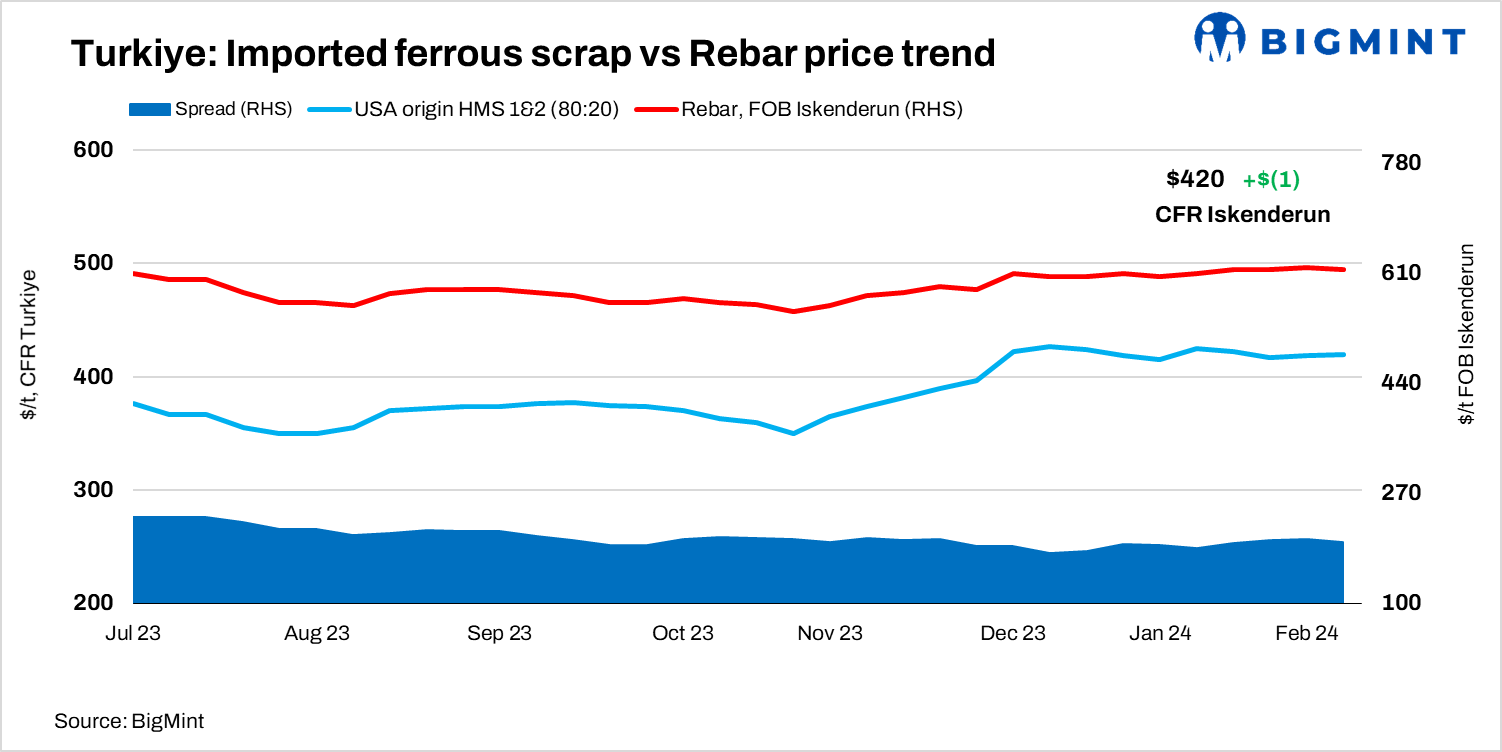
Turkish imported ferrous scrap prices saw a largely stable trend throughout this week amid moderate deals, with indicative tradable offers for HMS (80:20) hovering at $418-421/tonne (t) CFR. Near-term sentiment on the buy-side remained somewhat bearish, reflecting challenges for Turkish mills in selling finished steel products in a tough domestic market.
Sellers held firm against further price drops, citing constrained availability in Europe and stable domestic HMS prices in the US. Indicative prices for US/Baltic-origin HMS (80:20) hovered at $415-$420/t CFR, with most offers at $420/t CFR, while bids stood at $415/t CFR.
HMS collection costs surged to Euro 350/t delivered in the Baltic region and reached Euro 345-350/t delivered in the Benelux region. Limited HMS availability in Europe added to market uncertainties.
BigMint’s assessment for US-origin bulk HMS (80:20) witnessed a minimal hike of $1/t w-o-w, reaching $420/t CFR Turkiye.
The scrap-to-rebar spread was evaluated at $195-200/t, considering Turkish exported rebar was assessed at $612-618/t FOB Iskenderun.
Recent deals:
- A bulk cargo from the Netherlands comprising HMS (80:20) was booked by a Mediterranean region-based mill at $418/t CFR Turkiye.
- A US-origin bulk cargo with HMS (80:20) was booked by a West Marmara-based mill at $419.5/t on CFR Turkiye basis.
- A Europe-origin supplier sold HMS (80:20) bulk cargo to an Aegean region-based mill at $419/t CFR Turkiye.
- A Russia-based supplier sold 26,000 t of PNS in bulk cargo to a West Black Sea region-based mill at $432/t on CFR Turkiye basis.
- A steel mill in the Aegean region secured a Danish-origin cargo consisting of HMS (85:15) at $421/t for mid-March shipment on CFR Turkiye basis.
- A US-origin cargo was booked by a West Marmara-based steel mill, comprising HMS (80:20) at $422/t, CFR Turkiye.
- Another West Marmara-based steel mill booked bulk cargo of HMS (90:10) at $425/t on CFR Turkiye basis.
Domestic market: Some major Turkish steel mills increased their lira-denominated domestic scrap purchase prices at the start of the week. This was a response to a slight uptick in imported prices and the ongoing depreciation of the Turkish lira against the US dollar. Erdemir’s Eregli Steelworks raised its purchase price for DKP-grade scrap by TRY 250/t ($8/t) to TRY 13,050/t ($427/t), while Colakoglu and Asil Celik also adjusted their purchase prices upward. Colakoglu raised prices for DKP grade and extra grade domestic scrap to TRY 12,805/t and TRY 12,280/t, respectively, while Asil Celik set its DKP grade scrap purchase price at TRY 13,040/mt. Kroman, another Turkish steel producer, increased its DKP-grade scrap purchase price to TRY 12,500/t.
Lira depreciation: The Turkish lira continues to weaken, trading at around Lira 30.60/$1 following the resignation of the central bank governor. Fatih Karahan, the new governor, pledges to maintain tight monetary policies until the bank’s inflation target is met in 2024. He hints at possible further tightening but sees no immediate need for additional rate hikes.
Inflation forecasts remain steady: Karahan’s appointment coincides with a pause in interest rate hikes, with inflation expected to peak at 75%. Expectations are high for a more aggressive approach to tackling inflation under Karahan. Global institutions anticipate his policies may surpass those of his predecessor. Despite the leadership change, the central bank maintains inflation forecasts at 36% by end-2024, 14% by end-2025, and 9% by end-2026. January saw a slight inflation acceleration, attributed to temporary factors, with long-term uncertainties and upward risks.
Isdemir to build solar power plant: Turkish steel giant Isdemir plans to build a 140 MW solar power plant in Dicle, Diyarbakir, as part of its efforts to decarbonize steel production and reduce energy costs. The project, comprising 310,932 solar panels, awaits environmental approval and aims to start construction within 25 months. Isdemir targets a total installed capacity of 530 MW, including three other solar plants in Mardin, Batman, and Corum, within the next two and a half years.
Aligned with its emission reduction commitment, Isdemir’s parent company, Oyak Mining and Metallurgy Group, aims to cut Scope 1 and Scope 2 emissions by 25% by 2030, 40% by 2040, and achieve zero emissions by 2050. Despite facing challenges like high energy costs and sluggish demand, Isdemir remains steadfast in its sustainability goals.
Outlook: According to industry insiders, Turkish mills are expected to adopt a cautious approach, with minimal deals and targeting $412-415/t for European material. Meanwhile, US suppliers are expected to push prices above $420/t, citing limited availability and a stronger domestic scrap market.