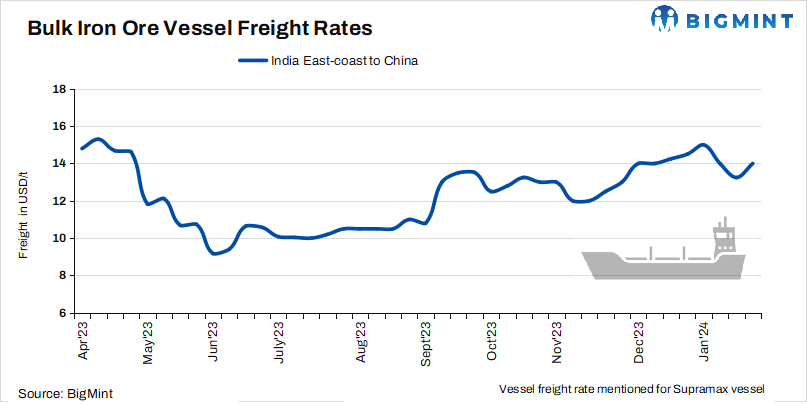
- Vessel freight rates for iron ore across major routes remain supported
- Approaching Chinese holidays may weigh on rates next week
Dry bulk freight rates are exhibiting a mixed trend this week in the global market. Lacklustre activities and a decrease in fresh trade volumes have kept market sentiments slow. The movement of ships have slowed due to the approaching Lunar holidays in China.
Asia-Pacific Supramax dry bulk (cargo capacity 50,000-55,000 t) freight rates for an iron ore-loaded vessel from the east coast of India to China were recorded at $14/t on 24 January, 2024, marking an increase of $0.75 w-o-w, according to BigMint’s assessment. Enquiries from China may pick up in the second half of the week with iron ore price recovery in China.
A ship owner stated, “Freights are showing mixed sentiment. Capesize vessel availability is high as Chinese players seem to have covered quite a bit for the approaching holidays, which may result in a drop in rates in the near term. However, low-grade iron ore export deals are still taking place which have kept freight rates for Supramax intact”.

A ship broker informed, “Freights have increased, as the demand from China has continued to remain normal. It may fall in mid-February due to the holidays. Trade volumes are volatile as movement of ships from the Indian coast to China is not facing any disruption due to conflict in Red Sea.”
Demand for large ships has slowed down as ships are stuck at Chinese ports due to delivery of early fixtures.
Meanwhile, the disturbance in the Red Sea still persists, affecting ship movements and creating challenges for shipping and insurance companies. Although there has not been any notable impact on bulk vessel freights, container freight rates have experienced an increase, influencing scrap vessel freight rates.

Outlook: Dry bulk freight rates are expected to decrease in the near term on limited demand during the Lunar holidays in China. Red Sea and Suez Canal conflicts are still unresolved which this is impacting movement of ships and posing challenges for ship owners and insurance companies.