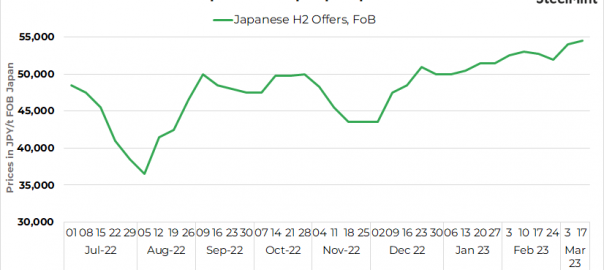
In the Kanto region, the supply and demand for steel scrap has been greatly relaxed. While inquiries from overseas such as South Korea and Vietnam have been slow, shippers have sporadically stopped receiving shipments.
Partly because the Gulf price has fallen ahead of manufacturers’ bid prices, the trend of market balls toward electric furnace manufacturers has intensified. Due to the arrival situation exceeding the required amount, electric furnace manufacturers are also moving to restrict the receipt of goods.
With the end of the fiscal year approaching, steady cargo movements are expected within the month, and downward pressure is further intensifying on regional market conditions, with electric furnace manufacturers “considering lowering purchase prices to control arrivals” (purchasing).
As of the 22nd, the Gulf Price (H2) is mainly 53,000~3,500 yen per ton. The price has recently reached a high of 54,000 yen, and it continues to be weak. On the other hand, the actual purchase price (H2) of electric furnace manufacturers in the Kanto region is around 54,500~5,500 yen per ton. The difference between the Gulf price and the manufacturer’s purchase price widened to around 1500~2,000 yen.
Shippers were said to be handling the loading at their feet with on-hand inventory, and it was pointed out that there were restrictions on receiving cargo at the Gulf yard.Although there is a deep-rooted sense of shortage among city yard operators, there seems to be a movement to rush the shipment of hand-held balls with an eye on the end of the fiscal year. For this reason, electric furnace manufacturers continued to receive goods at a high level on the 21st, with “very strong sales exceeding 100%” (purchasing manager) following the holiday on the 21st. It is necessary to control the arrival of goods due to restrictions on receipt of goods.
One of the reasons for the increase in cargo movement in the city was that “the stagnation of exports may have caused the cargo of emerging overseas scrapyard companies to move.”
In addition, Tokyo Steel, which has made clear its stance of competing against exports, reduced the purchase price by 500~1,000 yen per ton at all its bases on the 17th of last week. As the reason for the price reduction, he explained, “We adjusted for the fluctuation of the exchange rate in the direction of the appreciation of the yen” (Totetsu Purchase).
After that, the instability of foreign exchange prices against the backdrop of financial instability in Europe and the United States led to a rush to shipments by commercial yard operators who regarded the exchange rate as a factor for depreciation.
Note: This article has been published in accordance with an article exchange agreement between Japan Metal Daily and SteelMint.
Leave a Reply