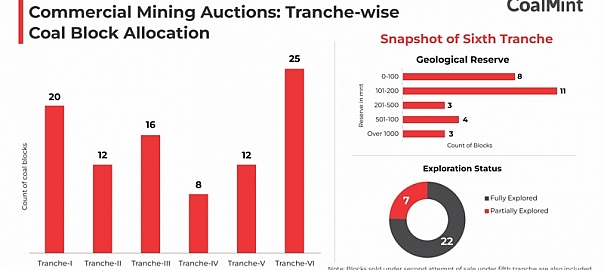
The Indian government’s latest attempt at allocating coal blocks via competitive bidding under the commercial mining scheme witnessed unprecedented response from market players. This also indicates a mini-revival in demand after the previous auctions had incited minimal interest.
Incidentally, post-receiving a record number of bids in the technical round, a total of 29 coal blocks were sold in the financial bidding round of the sixth tranche.
In particular, 25 blocks were earmarked specifically for the sixth tranche–marking the highest allocation recorded for a single tranche in these auctions. The remaining four blocks were allocated under the second attempt of sale under the fifth tranche.
Altogether, amongst these 29 blocks, 22 are fully explored while the remaining 7 are partially explored. These blocks have a combined geological reserve of around 8,160 million tonne (mnt), which translates into a peak rated capacity of 74.96 mnt annually (excluding the partially explored blocks).
Dominance of end-user industries
One of the important aspects of this round of auctions has been the strong participation seen from the end-user industries.
In the aftermath of the Russia-Ukraine war, global coal supply chains had altered which resulted in prices touching record highs.
This has prompted major industry players to acquire coal blocks for ensuring fuel security at a time domestic miner Coal India (CIL) has been reeling under pressure to meet soaring demand from the power sector.
Notably, almost 60% of the sold blocks in the sixth tranche were procured by the end-user segment comprising a mixed bag of steel, cement, and power firms.
Apart from the end-user segment, mining firms, including PSU companies like Gujarat Mineral Development Corporation and Assam Mineral Development Corporation, also emerged as highest bidders. Besides, some new players also featured in the winners list.

New initiatives to boost sales
Efforts put in by the government towards reviving the dwindling interest of bidders has also been key towards attaining higher allotment this term.
Importantly, the bidding process was made lucrative by providing several financial relaxations involving payment of upfront amount and performance bank guarantees.
Also, several measures were taken to improve features of the blocks that were offered on sale, as against the usual trend of repeatedly offering the same blocks under the rolling scheme.
In this regard, new blocks were introduced by modifying the mine boundaries of an existing block by trimming the area surrounding dense habitation and critical infrastructure that posed a threat to mining activities.
This measure garnered immediate response. For instance, Arjuni block was previously offered for sale in the fourth tranche, but went unsold. However, when it was transformed into two separate blocks — Arjuni (East) and Arjuni (West) in the sixth tranche, both were picked up.
In addition, few of the non-operational coal blocks surrendered by PSU companies such Banai-Bhalumuda, Baitrani West, Gare Palma-I and Khagra Joydev, included in the lot, were also successfully allocated in this round.
The outcome of the sixth tranche delivered productive result in terms of revenue share as well. Notably, the coal blocks under the sixth tranche were booked at an average final price of 25% as against 12% recorded in the fifth tranche.
Production set to rise
The newly-allocated blocks would take some time to get operationalized. Yet, these warrant increased coal production that would boost domestic availability in the coming years.
As per data provided by the coal ministry, India’s coal production exclusively from blocks allocated for captive/commercial purpose has crossed 100 mnt in the ongoing fiscal (FY23) for the first time.

Leave a Reply