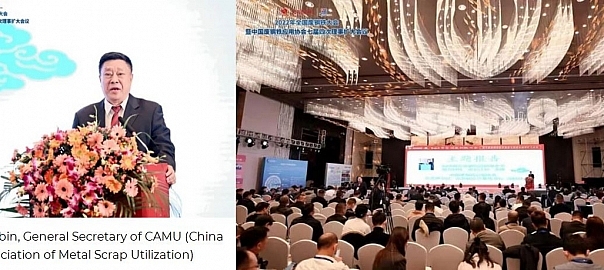
China’s recently-held National Iron and Steel Scrap Conference offered a prescription for increasing the generation, import and usage of ferrous scrap in steel-making.
Increasing scrap utilization in steel is imperative for China to meet its decarboisaion goals.
The conference, held over 22-24 February in Chengdu city in Sichaun province, was attended by senior representatives from the China Scrap Iron and Steel Utilization Association, Energy Conservation Department of the Ministry of Industry and Information Technology amongst others. It was co-hosted by China Iron and Steel Scrap Application Association, Sichuan Metallurgical Group Co Ltd, and Shanghai Ganglian E-Commerce Co Ltd, Sichuan Vanadium and Titanium Iron and Steel Industry Association, Jiangsu Shagang Group Co Ltd, and Chengdu Jiwei Wulian Group Co Ltd.
Key takeaways
The conference pointed out three main factors that inhibit the output and usage of scrap, apart from Covid and the economic downturn:
Tax challenges: The front-end of the scrap recycling link is dotted with small and fragmented entities whose transactions are mostly settled in cash, which results in the government losing out on VAT collection. A government circular resolved the issue, but increased their income tax burden due to which they are still avoid issuing invoices. This is resulting in back-end companies having to issue self-made vouchers which have their own risks.
High standards set for imported scrap: China has set high standards for imported scrap. The “content of inclusions” or adulteration is divided into three levels of not more than 0.3%, 0.8% and 1%. Thus, imported varieties that meet the Chinese standards are limited. The willingness of scrap exporters to comply with the standards is not strong. Imported products that do not meet the standards invite prosecution risks and mills are thus wary of importing.
Utilisation depends on scrap price: The amount of scrap used by mills is highly related to its price. When prices are higher than pig iron, and margins of mills are low, use of scrap declines, which affects its generation.
Four suggestions were put forward to resolve the above issues:
First, the tax rate should not be higher than 1%. The National Bureau of Statistics mandated in 2021 that utilization of waste resources will have an operating income profit of 3.82%, and an income tax burden of 0.96%. The conference proposed that as per the policy approved by the State Council in November 2022, the income tax rate should not be higher than 1%, in order to encourage recycling units to pay taxes, which will increase government revenue, and encourage scrap generation and usage.
Secondly, set new benchmarks for imported scrap. A suggestion was made to relax and revise the technical indicators, taking into account environmental protection goals so that scrap imports can increase.
Thirdly, promote upstream and downstream linkages of steel mills and scrap recycling units, to build an integrated platform for waste production (such as from steel, shipping, construction and automobiles). This will further increase scrap generation.
Lastly, incorporate scrap data into national statistics. This is essential since scrap is crucial to estimating to what extent green goals are being implemented.
Scrap to reduce dependence on iron ore: Scrap is a strategic resource, and promoting its utilization is of great significance since it will ensure supply of raw materials in the steel industry, alleviate the dependence on iron ore imports, and promote carbon reduction.
Footnote
Increasing scrap utilization in the steel industry is imperative and intrinsic to the implementation of China’s Cornerstone Policy. Through the latter, the country plans to increase iron ore output within its own shores, find new mines, fast-track approvals for operation, get more mining rights in overseas markets, and, importantly, increase both imports and domestic recycling of scrap.

Leave a Reply