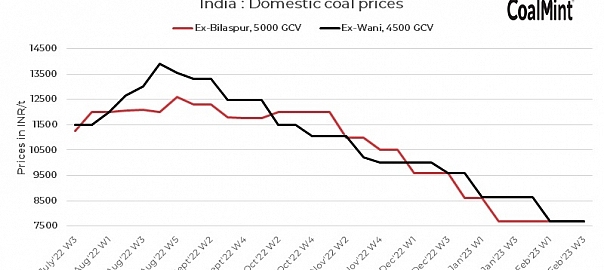
Prices of mid-GCV domestic coal (falling under grades G8-G12) remained unchanged in Wani, Maharashtra, and Chhattisgarh’s Bilaspur last week as the market witnessed an equilibrium in demand and supply. However, price dynamics are expected to change with the auctions to be held Western Coalfields Limited (WCL) and South Eastern Coalfields Limited (SECL) in February.
Mid-GCV coal prices stable
Prices of 4,500 GCV coal in Wani stood at INR 7,700/t on 20 February, while 5,000 GCV coal was assessed at INR 7,700/t in Chhattisgarh’s Bilaspur. Both prices remained unchanged w-o-w.
There has been no further improvement in coal demand from industries and additional procurement from the brick industry has stabilised. On the supply side, there has been no shortage of material. Compared to December auctions, the weighted average bid price of G9 grade coal increased by 2% at the spot e-auction of South Eastern Coalfields Limited (SECL) on 7 February.
However, low-GCV coal prices have dropped amid a surge in supplies. The weighted average bid price of G14 coal dropped by 19% at SECL’s spot e-auction compared to December auction.
Fresh auctions: Will prices drop?
In an unprecedented development, SECL and WCL have both announced a second spot e-auction for coal sales in February. The offerings by both miners are similar in quantity compared to the previous auction. WCL is offering 299,000 t of coal for auction on 23 Febuary, while SECL will conduct an e-auction for 1.79 million tonnes (mnt) of non-coking coal on 21 February.
Market participants are weighing how increase in supplies may affect pricing. Meanwhile, the huge offering of 1 mnt of G11 coal from the Dipka, Gevra, and Kusmunda mines seems to be the draw of SECL’s auction. This is expected to affect coal prices in the mid-GCV range.
“We are expecting a price drop of 10-15% from the previous auctions,” a dealer source in Bilaspur told CoalMint.
Another trader from Wani said, “Prices will depend on the direct participation of industries in the spot auction as they would like to stock up before the onset of summer when prices might go up.”
“At present, demand is on the lower side. If end-users are unable to absorb additional offerings at auctions, the price drop is likely to be steeper,” he added.
Leave a Reply