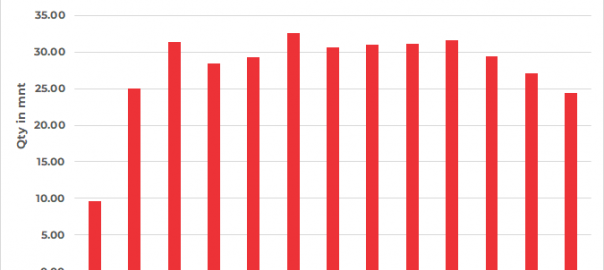
Indonesia’s thermal coal exports decreased by 10% m-o-m to 24.4 million tonnes (mnt) in January 2023 as against 27.05 mnt in December, CoalMint data show.

Qty in mnt
China was the largest importer of Indonesian coal at 7.02 mnt in January, down 23% as against 9.17 mnt in December. China has also resumed coal imports from Australia.
Indonesian shipments to India stood at 5.07 mnt. Shipments picked up by 9% m-o-m in January. Power demand and production have been unusually high in January and the government’s recent mandate obligating operators of coal-based power plants to increase inventories by importing at least 6% of their coal demand by weight and easing restrictions on coal blending is positive for imports.
India has been focusing on improving domestic coal production to achieve its FY’23 target of 900 mnt. India’s largest coal producer, Coal India Ltd. (CIL), saw a production growth of 11% y-o-y to almost 72 mnt in January. CIL’s production edged up by 8% m-o-m.
Indonesia has become the preferred alternative for some Asian countries amid changed global trade dynamics. Apart from India, Indonesian coal shipments to South Korea and Malaysia also increased by 38% and 10% on-month to 2.86 mnt and 1.51 mnt, respectively, in January.
Indonesian coal exports to Vietnam, however, fell by 38% as the country used more of domestic coal and avoided imports amid high prices. Vietnam’s coal demand is expected to increase in 2023 to 45.89 mnt, as per state power producer Vietnam Electricity (EVN). Indonesia: Production, export targets
Indonesia has planned to churn out about 695 mnt of coal and export about 518 mnt in 2023, as per Energy and Mineral Resources Minister Arifin Tasrif. In 2022, the country produced 687 mnt of coal, above the set target despite an export ban imposed in January last year and heavy rains that disrupted operations.
Prices are expected to remain on the higher side in 2023 amid sustained demand for coal due to high energy prices worldwide and also because coal prices remain elevated since the global energy crisis following the war in Ukraine last year.

Leave a Reply