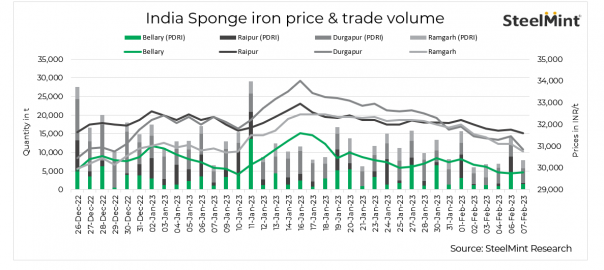
Indian sponge iron prices fell by INR 200-600/t in some key locations. Meanwhile, prices in Bellary inched up by INR 50/t. Prices continued to fall in the northern and eastern regions of the country as spot trading remained limited. Suppliers faced selling pressure resulting in the continuous reduction in both offers and bids. Uncertain price swings, according to sources, impacted spot trade volumes.
About 11,600 t of sponge iron transactions were recorded today in India as against 19,470 t on 6 February.
Snapshots of key markets
- Rourkela: Prices fell due to reduced offers, followed by an unpredictable prices in north India. Buyers were cautious and purchased material based on immediate requirement and lower offers. As a result, prices dropped.
- Raipur: No buying was observed. Market remained slow and prices of semi-finished steel showed a declining curve. Prices offered by sellers were not accepted in the market and buyers’ refrained to book at the offered price levels. Northern region market showed downtrend. Since, sufficient booking was done in past few days buyers showed less initiatives to book orders currently.
- Bellary: Buying activity in sponge iron remained sluggish today as buyers appeared less interested in booking material at current market offerings. Market participants are in anticipation of further price corrections. Meanwhile, semi-finished steel prices across India continued to fall d-o-d.
- Durgapur: Sellers’ reduced offers due to bearish sentiments from the northern region. Buyers are cautious for booking which ultimately restricted spot trades throughout the day.
- Ramgarh: Slow trades resulted in limited transactions in the region. Buyers’ side are very cautious while booking material. Low finished steel demand affected semis movement in the region.
Rationale –
This index has been derived based on transactions, offers, bids and indicative price data sets. Transactions are considered as T1 and given a weightage of 50% whereas other data sets are considered as T2 and given a weightage of the balance 50%.
Click for detailed methodology
 T1 – Trade, T2 – Offer/Bid/Indicative


Leave a Reply