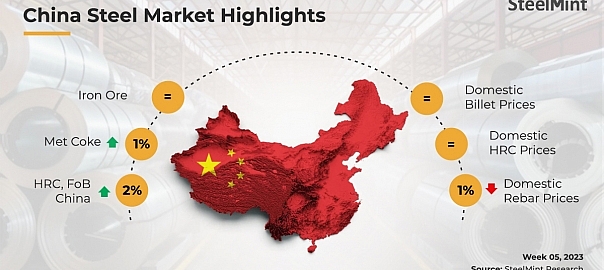
Chinese steel prices exhibited mixed trends this week. The resumption of market activities post holidays has been slow, which is impacting both demand and logistics in the country.
The average daily crude steel output of CISA-affiliated mills stood at 1.93 million tonnes (mnt) in mid-January 2023, up 0.57% from early-January 2023.
Steel inventory at CISA mills stood at 16.06 mnt in mid-January, up 1.18 mnt or 7.94% from 14.88 mnt in early-January. Compared with mid-December, inventory inched up by 78,800 t, or 0.49%.
Product-wise sentiments-
1. China spot iron ore prices remain rangebound post-holidays: Chinese spot iron ore fines Fe 62% prices opened at $126.65/t CNF China for the week and were assessed at $126.25/t CNF China towards the weekend. Seaborne iron ore prices are largely stable on limited buying for February arrival cargoes.
While the reopening of the Chinese borders seemed to have invoked bullish market sentiments, according to a Chinese mill source, some participants held a more optimistic view on the iron ore demand outlook post the holidays.
Iron ore inventory at major Chinese ports stood at 136.5 mn t on 2 February 2023 up by 2.2 mn t as against 134.3 mn t on 18 Jan’23, as per data maintained by SteelHome.
a) Spot pellet premium remains stable: Spot pellet premium for Fe 65% grade pellets was assessed at $17.1/t, remained stable against 20 Jan’23.
Asian pellet premiums were unchanged with sluggish demand for seaborne pellets from China.
b) Spot lump premium edges up: Spot lump premium stood at $0.1370/dmtu, up as against $0.1150/dmtu on 20 Jan’23.
Lump premiums to improve further amid improving margins, but with lumps also facing import losses, coupled with the low pellet prices, some expect a cap to the rise in lump premiums in the short term.
2. Coking coal prices rise w-o-w: Australian coking coal prices increased by $18/t w-o-w to $350/t FOB against $332/t FOB last week. Prices rose amid supply tightness because of the closure of rail corridor in Queensland and wet weather in Australia. In addition, global demand also supported prices.
3. China’s domestic billet prices edge down post holidays: Steel billet prices in China’s Tangshan fell marginally by RMB 10/t ($1/t) to RMB 3,810/t ($562/t), including 13% VAT, on 3 February. A decline in futures over the week pulled down billet prices. According to data maintained with SteelMint, China’s SHFE rebar futures contract for May 2023 delivery closed at RMB 4,055/t ($598/t) on 3 February, a sharp decrease of RMB 124/t ($18/t) as against the closing on 20 January, 2023.
4. HRC export offers rise post holidays: China’s HRC export offers rose marginally by $10/t w-o-w to $655/t FOB as against $645/t FOB two weeks ago. The optimistic outlook for the steel market prompted mills to increase their offers.
Domestic HRC prices dropped marginally by RMB 10/t ($1/t) to RMB 4,090/t ($604/t) compared with RMB 4,100/t ($605/t) prior two weeks. The domestic HRC market demand was poor after the week-long Lunar New Year holiday from 21-27 January 2023.
HRC futures on SHFE are also on decline post the holiday period. The HRC futures (May 2023 contract) fell by RMB 43/t ($6/t) d-o-d to RMB 4,056/t ($599/t) as on 03 February. This was around RMB 4,198/t ($620/t) as on 31 January.
5. Domestic rebar prices fall amid holidays: China’s domestic rebar prices fell to RMB 4,130/t ($610/t) as against RMB 4,160 ($614/t) two weeks ago, mainly due to the lack of post-holiday demand recovery. Moreover, many construction workers and truck drivers were still on holiday.
6. Shagang Steel raises rebar prices: China’s Shagang Steel raised rebar prices by RMB 200/t ($29/t), while wire rods and coiled rebars prices increased by RMB 150/t ($22/t) for early-Feb’23 sales. Effective prices-
- Rebar (16-25 mm): RMB 4,400/t ($649/t)
- Wire rods (6-10 mm): RMB 4,560/t ($673/t)
- Coiled rebar (8-10 mm): RMB 4,650/t ($686/t).
- All prices are ex-mill, including VAT.


Leave a Reply