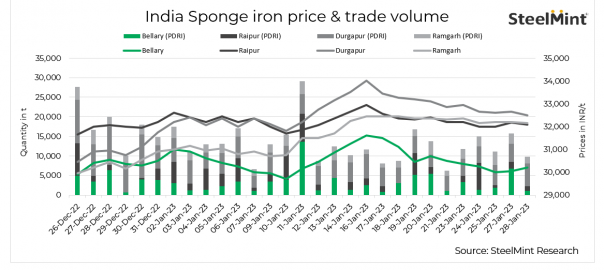
Indian sponge iron prices fell by INR 50-150/t in some key locations. For instance, while prices in the northern and eastern regions rose, those in the south were up by INR 150/t amid high raw material costs.
Prices continued to fall in the northern and eastern zones as spot trade remained limited. This exerted a downward pressure on prices. As a result, a slight selling pressure was felt on suppliers, resulting in a consistent drop in both offers and bids. The correction in prices made market participants wary, resulting in fewer enquiries. Sources said uncertain price movements impacted spot trade volumes.
About 13,350 t of sponge iron transactions were recorded today in India as against 21,090 t on 27 January.
Snapshots of key markets
- Rourkela: Prices trended down on lower bids followed by volatile prices in northern India. Buyers were cautious and procured material as per immediate needs and on lower offers. Thus, prices continued to soften.
- Raipur: Moderate bookings were observed amid price drops. The market continued to show a downward trend, decreasing by INR 100/t. Limited trading activity was seen at lower prices. Buyers were hesitant to book material at higher offers as the market is volatile and prices may fluctuate post-lifting of production restrictions on sponge plants in Odisha. Hence, they will wait to see the price movements in the coming week before taking any buying decision.
- Bellary: Sponge iron prices were up today. However, demand was limited, resulting in a drop in overall sales. Suppliers raised offers on higher raw material prices.
- Durgapur: Prices went down today due to moderate demand for sponge in this region. Sellers reduced offers to induce some deals which were more or less limited today. Prices saw a fall of INR 150/t d-o-d.
- Ramgarh: Prices remained range-bound today. Limited enquiries impacted trade activities in the region due to slow demand. Market participants were noticed losing confidence in booking material due to volatile price movements. Need-based transactions were recorded from the buyers’ side.
Rationale –
This index has been derived based on transactions, offers, bids and indicative price data sets. Transactions are considered as T1 and given a weightage of 50% whereas other data sets are considered as T2 and given a weightage of the balance 50%.
Click for detailed methodology
 T1 – Trade, T2 – Offer/Bid/Indicative


Leave a Reply