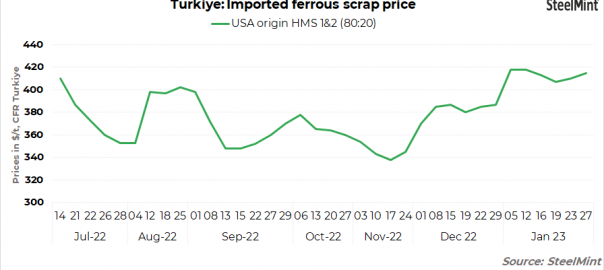
Global imported scrap market leader Turkiye continued scrap booking throughout this week. A bunch of deals were concluded out of which two were from the US and the other two from the UK and Europe respectively. Prices remained rangebound compared to last week. Scrap importers in Turkiye were still looking for March shipment cargoes, and further bookings are expected.
SteelMint’s daily assessment for HMS 1&2 (80:20) from the US stood at $415/t CFR Turkiye, up by $5/t w-o-w.
Recent deals:
- A Mediterranean region-based steel mill booked a US-origin cargo comprising HMS(90:10) at $415.5/t CFR Turkiye on 24 January.
- A black sea region-based mill booked a US-origin cargo comprising HMS(80:20) at $414/t CFR Turkiye on 26 January.
- A West Marmara region-based steel mill booked a Europe-origin cargo on 27 January comprising shredded and HMS(80:20) at $434/t and $414/t CFR Turkiye respectively .
- A Mediterranean-based steel mill booked a UK-origin cargo comprising HMS (80:20) at $410/t and shredded with bonus at $430/t CFR Turkiye on 27 January.
Market highlights-
- Bid-offer mismatch in billet market: Offers of Turkish mills are mostly stable w-o-w. Billets are available at $630-650/t exw. Although steel producers are trying to maintain price levels, referring to scrap prices, buyers are seeking to lower prices amid weak finished steel demand. However, the slowdown in rebar sales can be a game-changer.
- Local rebar prices hold ground: Domestic rebar prices are at $700-720/t exw depending on the region, which is generally stable. Business activity in the local rebar market slowed down this week but prices remained unchanged due to firm raw materials tags. The situation in the export rebar sector remains unfavorable as no improvement has been seen in buying activity from overseas buyers.
- Turkish energy price regulator to lower cap: The Turkish energy regulator’s decision to cut the country’s power price cap in February has given the market a push. As a consequence, industrial users like electric arc furnace mills should pay about 12% less for electricity, and lower electricity prices should also mean less need for mills to cut costs elsewhere, including scrap procurement. The reduction in power was equivalent to a $25/t savings for steel, according to a market expert in Turkiye.
Outlook:
Turkish mills are not expected to reduce expenses, particularly for scrap purchases, which is a direct result of lower power prices. This may relieve the pressure on scrap pricing and motivate suppliers to ask for price hikes.
Leave a Reply