- Logistics strikes in South Africa hit supplies
- Price fluctuations drive smelters to procure in small parcels
- Manganese ore imports may rise due to bullish steel market outlook
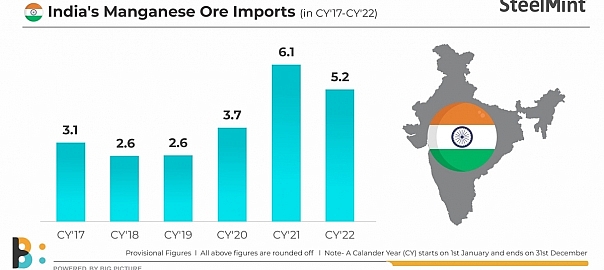
Morning Brief: India’s manganese ore imports fell 16% y-o-y to 5.14 million tonnes (mnt) in calendar year 2022 (CY22) compared to 6.12 mnt recorded in the preceding year, as per data maintained with SteelMint. 
Leading suppliers see volumes fall in CY22
Imports from South Africa fall 15%: South Africa continued to remain the largest exporter of manganese ore to India. However, volumes decreased 15% to 2.72 mnt in CY22 against 3.20 mnt in CY21.
Gabon supplies dip 3%: Gabonese manganese ore imports dipped 3% to 1.67 mnt in CY22 against 1.72 mnt in CY21, on higher prices. Gabonese manganese ore was offered at around $4.7/dmtu for December shipment, up $0.26/dmtu (6%) m-o-m from November.
Imports from Brazil, Australia down: India’s imports of manganese ore from Brazil were down 57% to 0.126 mnt in CY22 against 0.291 mnt in CY21. Volumes from Australia were also down 26% to 0.52 mnt last year against 0.70 mnt in the previous year.
Zambian imports down 38%: India’s imports from Zambia were sharply down by 38% to 0.018 mnt in CY22 comparison to 0.029 mnt in CY21.
Factors that pulled down manganese ore imports last year
Supply-side, rather than demand, seemed to be the factors that led to the drop in imports since India’s crude steel production rose 6% y-o-y in 2022.
Supply disruptions from South Africa: South Africa is traditionally the largest exporter of manganese ore to India, although the material is of low quality. But its supplies were impacted by a strike at Transnet, the national logistics behemoth. This made Indian buyers turn to procuring high-grade ore from Australia and Brazil even though volumes from both these countries showed a y-o-y drop of 26% and 55% respectively. Use of better grades led to more yield at lesser volume and an overall drop in imports, SteelMint understands.
Shift in import pattern: Mills’ import pattern also changed last year. They imported in bulk and more than required especially towards December in 2021 — when prices were low. But, the time frame within which smelters put this material to use spilled over into 2022, necessitating lower procurements last year. In fact, low port inventories and the possibility of import prices rising subsequently had driven buyers to book material heavily in late 2021. 
Also, due to the price fluctuations in 2022, smelters imported in small volumes.
Electricity tariff revision: Producers were impacted by higher input costs in the form of raised power tariffs at both key silico manganese production hubs in India. Power tariffs in the Durgapur region increased by around a sharp 40% to INR 6.25 per unit in CY22 against INR 4.5 per unit in CY21.
In Raipur tariffs were up by 23% y-o-y to INR 6.5 per unit against INR 5.30 per unit in 2021.
These raised tariffs hiked the cost of production of silico manganese by INR 4,000-5,000/tonne (which are currently hovering at around INR 80,000-81,000/t), leading to lower capacity utilization by the smelters.
Rupee slide: The Indian rupee’s slide also impacted manganese ore imports, making the material costlier in India. The rupee averaged 78.5 in CY22 against 73.9 in CY21, denoting it eroded by 6% y-o-y, adding to the higher cost of production.
Outlook
India’s manganese ore imports may rise in the short to medium term on the back of the bullish steel market outlook this year.
Manganese ore prices have risen due to rising energy tariffs and material handling expenses.
This uptrend is likely to continue in the near future, supported by the expected rise in global steel production this year. With steel demand from Europe showing a revival, demand and thus prices of manganese alloys will also possibly rise.

Leave a Reply