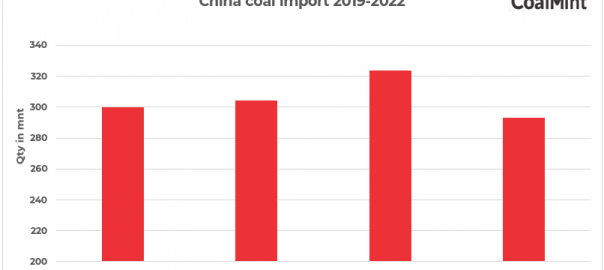
China’s total coal imports in 2022 posted a marked reduction of 9.2% compared with 2021 when it was 293 million tonnes, the lowest in last four years, showed data from General Administration of Customs.
The monthly imports presented an untypical “W” pattern. In contrast with 2021, only five months in 2022 registered positive y-o-y growths.

This could be attributed mainly to two factors. The first is Indonesia’s adjustment of coal export policy and energy crisis brought up by Russia-Ukraine conflict. As more Indonesian and US coal flowed to Europe, while only some cargoes were exported to China.
The second reason is China’s strong stance in stabilising domestic coal prices within a reasonable range, strengthened efforts to boost supply and guarantee of mid and long-term contracts. These weakened competitiveness of imported coal and curbed end-buyers’ appetite for imported coal.
As for 2023, constraints remain and it would be hard for Chinese coal imports to increase significantly.

Global energy trading landscape can be further affected by ongoing geopolitical tensions, which will, in turn, push international energy prices higher.
By 2026, all long-term LNG contracts that can be supplied at steady prices were sold out, according to Japan’s Ministry of Economy, Trade and Industry. The US and Qatar are two suppliers that are able to sell additional LNG to Europe, but they almost have no new production capacity to commission by 2026.
Given the alternative relations between LNG and coal, the supply tightness of LNG may result in its price buoyance again in Europe and push the EU to increase purchases of coal. The move will reduce cargoes availability to China and drive up global coal prices.
China may face difficulties in boosting purchases of Indonesian coal due to the country’s DMO policy and the increase in purchasing demand from Europe. By contrast, the optimisation of Customs clearance will help facilitate import of Mongolian coal in 2023.
The main variables are Russian and Australian coals. Although, the former is actively strengthening the export of coal to China, the increment still needs the improvement of transport capacity, and the latter depends on the change of relations between the two countries.
Note: This article has been exchanged under the article exchange agreement between CoalMint and Sxcoal.

Leave a Reply