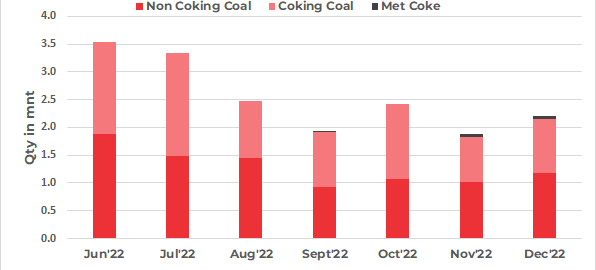
Vietnam is a key coal-importing country in Asia. However, its total coal imports fell sharply by 62% to 2.2 mnt in December 2022 against 3.53 mnt in June.*
While coking and thermal coal were imported in nearly equal quantities, the drop in coking coal imports was higher at 41% (0.81 mnt) against 37% in the case of thermal coal (1.18 mnt) if December figures are compared with June. The country’s leading steel producer, Hao Phat Group, had suspended two-thirds of its operations in the last quarter of 2022 as a measure to survive the downturn in the steel sector. Vietnam’s finished steel production is estimated to have declined by 11% y-o-y to approximately 30 mnt in 2022.
In the case of thermal coal, the drop was majorly because of reduced industrial activities and fall in power demand. Vietnam’s Purchasing Manager Index (PMI) dropped 12% to 46.4 in December from 52.7 in June. The PMI reflects the prevailing direction of economic trends in the manufacturing and service sectors. Also, total power generation in December fell by 13% to 20,649 GWh compared with June. Coal accounts for 34% of Vietnam’s total power generation.
While Vietnam didn’t import any met coke in the June-August period, in the last quarter of 2022 imports stood at 0.13 mnt, mainly from Japan.

Country-wise, more than half the imports arrived from Australia followed by Indonesia and Russia. Imports from Australia dropped 53% to 1.22 mnt as against 2.6 mnt in June. The Russia-Ukraine war and subsequent sanctions on Russian coal forced the latter to divert its exports to Asian countries. Hence, Vietnam imported 167,500 t in December from 94,000 t in June.
Imports from Indonesia remained largely stable at 0.71 mnt in December against June.
What lies ahead?
Vietnam’s coal demand is expected to increase in 2023 to 45.9 mnt, as per state power producer Vietnam Electricity (EVN). This may result in increased demand for thermal coal. While steel demand sentiments look sluggish globally due to recessionary pressure in Europe, the US and China, Vietnam’s coking coal requirement is also expected to remain sluggish.
However, there may be a change in country-wise sourcing of coal by Vietnam. This is because China, which had put an unofficial ban on Australian coal imports in 2020, has recently permitted resumption of imports from Australia. With China slowly lifting its ban on Australian coal, the latter’s exports to Vietnam are expected to drop as the same will get costlier. Also because of increased demand from the European market amid sanctions on Russian coal, premium Australian coal will be diverted to the EU resulting in a drop in shipments to Vietnam. More of Russian coal may find its way to the Vietnamese market, however, as Russia is exclusively targeting Asian countries amid sanctions imposed on it by the EU, US, Japan and South Korea.
*corrected

Leave a Reply