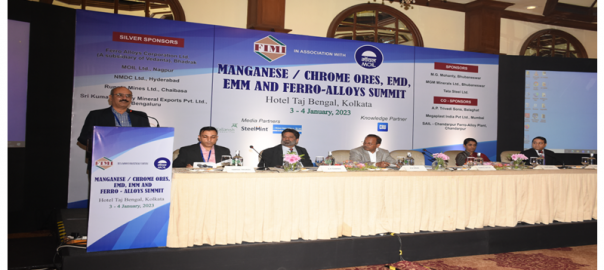
With the deadly phase of Covid over, a turnaround in the ferro alloys industry is likely while there should be a stress on raising ore production from existing mines to feed domestic demand, feel experts at the “Manganese/Chrome Ores, EMD, EMM And Ferro Alloys Summit”, recently held in Kolkata.
The Federation of Indian Mineral Industries (FIMI) and Manganese Ore India Limited (MOIL) jointly organised the 2-day event. SteelMint brings its readers the key takeaways from the conference:
How to meet India’s domestic manganese ore demand in long term?
Manganese ore production in India will have to be raised to fully meet the domestic demand by enhancing output from the existing mines, and by opening additional virgin deposits. The industry can raise supply of manganese ore by acquiring mines overseas as well. India is deficient in high grade ore, and low phosphorous manganese reserves. This necessitates imports of high-grade ore to blend with domestic quality manganese ore for production of required manganese alloys. Moreover, experts opined that focused attention is needed to ensure higher rate of recovery of manganese and improve the quality of ores by engaging in beneficiation and sintering processes.
In this context, Geological Survey of India (GSI) and other nominated agencies should undertake extensive drilling to identify new ore deposits at higher depths. For example, deep sea nodules can be a “potential resource” for manganese in the future. Eminent speakers also stressed on the need to renew mining leases and the grant of new leases can be expedited by a ‘single window clearance system’, especially in respect of obtaining environment and forest clearances.
Gloomy days likely to be over for manganese alloys
Since the long, ‘deadly phase’ of Covid is over — which was characterized by lockdowns and logistics issues that played spoilsport for major manufacturers — a turnaround is likely. Geopolitical tensions like the Ukraine-Russia war are de-escalating into peaceful negotiations, backed by superpowers, including the US. This will slowly but firmly change the global atmosphere for the better.
Earlier, in CY22 Europe, China and the US faced varied challenges. Production curtailment by steel mills continued. Meanwhile, a slight relief last month in energy costs boosted market confidence. If European mills and industry captains manage to cope with the “weak macro-economic condition”, 2023 will be a better year for the subcontinent, feel experts.
In China, a slight uptick in prices is forecasted on the back of the removal of Covid restrictions in major steel producing regions and expected government stimuli to lift the economy affected by the housing sector fiasco.
The US, which is reeling under a general slowdown in line with the global economy, has also geared up to make the most from this favourable time where all stakeholders of manganese alloys expect the gloomy days to be over with the market moving towards correction.
Nearly 1.6 mnt ferro chrome capacity expansion in pipeline globally
India produced 1.3 mnt of ferro chrome during FY22 while its consumption was 0.6 mnt, said Debraj Mukherjee, Assistant General Manager, Tata Steel & Mining Limited. “Keeping in mind the demand drivers of India’s chrome business, the nation is poised to reap rich dividends out of its manufacturing and construction output and vehicle production. Overall, rising demand in India and government policies to establish the nation as a ‘manufacturing hub’ is expected to support domestic demand of alloys in the domestic market,” Mukherjee explained.
Nearly 1.6 mnt of ferro chrome production capacity expansion is in the pipeline in the world. Here, some key ferro chrome smelter projects are slated to be completed in the next 2-3 years. Undoubtedly, these key projects will boost the global chrome value chain.
Manganese ore imports rebound
South African ore exports fell sharply in October 2022 due to the Transnet strike. But exports to India have again increased to May-June levels as importers have started taking in low-priced shipments. With stocks returning to normal levels, the low-priced ore can be fed into furnaces quickly.
Steel to remain main driver of manganese demand
Interestingly, in spite of the increasing demand for batteries due to the popularity of electronic vehicles (EVs) across the globe, by 2030 the share of batteries in total manganese demand will reach only 3%. This forecast reaffirms steel industry’s ‘unique position’ as the main driver of manganese demand.
Leave a Reply