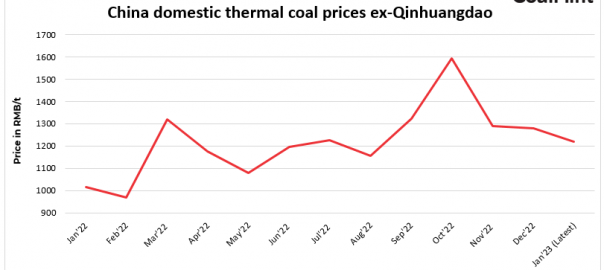
China’s domestic thermal coal prices started to fall on January 12, snapping a week-long uptick, as participants became cautious amid news that the country could lift the official ban on Australian imports earlier than expected.
According to market sources, Guangdong’s regional customs, on January 12, received a notice from highly-placed authorities that Australian coal can now be declared with no restrictions henceforth.
It was also said that Chinese traders are working to resume imports of Australian coal, although no specific trades were heard in the market.
This news, if true, will be the latest development since China allowed four state-owned companies to resume procurement of Australian coal early this month, traders said.
Once the embargo is fully lifted, the inflow of Australian coal will put pressure on domestic miners, they said, adding that the ban removal could come much sooner than previously expected.
In fact, the pressure has been felt in the domestic market, with some traders cutting their offers by RMB 10-20/tonne (t) to expedite sales.
On January 12, the benchmark 5,500 Kcal/kg NAR grade of thermal coal was mainly offered at RMB 1,220-1,245/t FOB with VAT in the northern ports, down from RMB 1,230-1,250/t a day earlier.
Cargoes of 5,000 Kcal/kg NAR were mainly offered at RMB 1,080-1,100/t FOB, almost unchanged from RMB 1,090-1,100/t a day earlier. There were few offers for 4,500 Kcal/kg NAR coal, with only one Hebei-based trader reporting an offer of RMB 930/t FOB.
The prices of high-CV thermal coal took the brunt as Chinese utilities are mainly seeking high-CV cargoes from Australia.
Some Shaanxi cargoes, which had a premium of RMB 20-30/t over common grades in the market, have been offered with the premium wiped out.
A Tangshan-based trader offered a 0.4%-sulphur Shaanxi 5,500 Kcal/kg NAR coal at RMB 1,220-1,230/t, after selling a 0.5%-sulphur cargo at RMB 1,245/t. “Demand for high-CV cargoes has waned,” the trader said.
Mid- and low-CV cargoes are less affected, but trading activity seems to have slowed. A Guangdong-based trader informed that the highest offer for late-January 5,000 Kcal/kg NAR coal with 1% sulphur was seen at RMB 1,080/t.
A Zhejiang-based trader informed that a deal for Shanxi low-sulphur coal of this grade was offered at RMB 1,100/t. He added that cheaper Australian coal will weigh on the domestic prices.
Another Zhejiang-based trader told Sxcoal that his Shanxi 5,000 Kcal/kg NAR cargo with 0.6% sulphfur could not match buying interest at RMB 1,090/t. Some high-sulphur cargoes were offered at RMB 1,070/t, also failing to attract buyers.
Australian cargoes have maintained clear price advantages against Chinese domestic coal. As of January 11, Australian 5,500 Kcal/kg NAR thermal coal was priced at $130-135/t FOB Newcastle. On the same day, Shanxi 5,500 Kcal/kg NAR coal was assessed at RMB 1,360/t at Guangzhou Port, ex-stock with VAT, or $178.3/t. After factoring in the freight rates and port charges, Australian coal is still $8-10/t lower than current domestic prices.
However, most Australian cargoes may not arrive in China until February, when coal demand is typically dull and domestic coal prices would fall as well.
Note: This article has been exchanged under the article exchange agreement between CoalMint and Sxcoal.
Leave a Reply