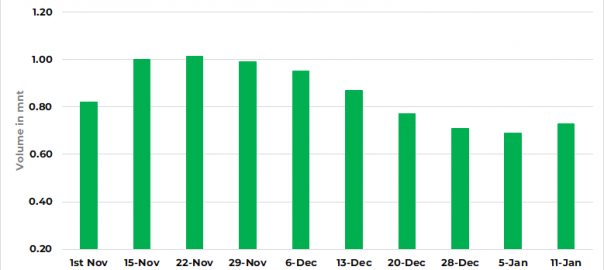
After consecutive drops over the previous weeks, South Korean steelmakers’ scrap inventories rose at the start of the New Year. According to a SteelDaily report, major steelmakers had 731,000 tonnes (t) of scrap stocks in the second week of January, an increase of 6% w-o-w over the 687,000 t recorded the previous week. Seven weeks later, the downward trend in inventories stopped, and an upward trend resumed.
Steelmakers’ scrap inventories have increased in tandem with the year’s soaring rate of scrap distribution.
Company-wise inventory:
Hyundai Steel: In particular, Hyundai Steel’s Dangjin Steelworks was the only steelmaker to show a decrease in inventory. At Hyundai Steel, the combined inventory of Incheon, Pohang, and Dangjin decreased by 4% from the previous week.
Dongkuk and Hwan Steel: Inventories at Dongkuk Steel and Hwanyoung Steel increased 11% and 23%, respectively, but steelmakers’ total inventory decreased by 2% from the previous week due to inventory decline at the Dangjin Steelworks.
Daehan and YK Steel: Inventory surges at Daehan Steel and YK Steel stand out. Inventories at Daehan Steel and YK Steel, which had been rapidly declining until the end of the year, are estimated to have more than doubled in one week as inventory soared as soon as the year began.
Southern region: Southern region-based steelmakers led the way in terms of inventory growth. Steelmakers’ inventories grew quickly at the beginning of the year as the so-called “warehousing volume exploded” in the southern region. Steelmakers in the region had 322,000 t of inventory this week, up 53,000 t (20%) from the previous week. It is a significant increase, even taking into account the possibility that some error occurred at the time of the survey due to the holiday at the beginning of the year.
Other regions: Steelmakers’ inventory growth is a little slower than it is in the south. Due to the lack of operation schedules in January, there was not much demand for scrap at Daehan Steel and YK Steel. However, inventory growth appears to have been notable due to a rise in warehousing volume and price reductions that began in Busan-Gyeongnam.
Note: This article has been published in accordance with an article exchange agreement between SteelDaily and SteelMint.
Leave a Reply