- Positive export signals, higher global offers, good infra demand raise prices
- Increased raw material costs a bother
- HRC-rebar spread to normalize as cost pressure eases for IFs
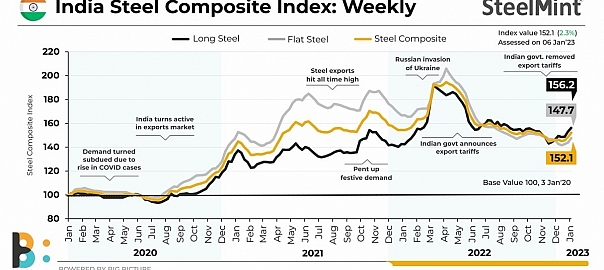
Morning Brief: The India Steel Composite Index rose to a three-month high for the week ended 6 January, 2023. It closed at 152.10 points (148.60 points in the previous week), rising 2.3% w-o-w. The flats index also rose 2.60% to 147.70 (144) points. Longs upped 2.10% to 156.20 (153.10) points w-o-w. This is the second week in a row that the index has remained firm.

Factors boosting the index
Flats scenario optimistic
1. Mills raise list prices of flats: A key reason for the w-o-w index uptrend lies in the fact that tier-1 mills, last week, raised their list prices of hot rolled and cold rolled coils by INR 1,500-2,000/t. A few factors encouraged this hike. One, global offers have increased. Two, imports of hot rolled coils (HRCs) have now become unviable with the increase in global prices.

2. Exports prospects look good: The exports front looks rather positive. Mills have left behind the hindrance of the export tax. Globally, demand looks good with the European buyers set to return to the market next week. The fact that the exports front looks positive has also allowed mills to raise domestic finished flats prices. It may be mentioned, flats comprise over 60% of India’s steel exports.
3. Raw material prices rise: Prices of steel-making raw materials like iron ore and coking coal have risen lately. NMDC Chhattisgarh recently hiked iron ore prices by up to a substantial INR 600/t ($7/t). Prices of lump ores were raised by up to INR 500-600/t ($6-7/t) and fines by INR 500/t ($6/t), effective from 1 January, 2023.
Coking coal prices have also risen in January to $310/t levels from $279/t in December 2022.
That apart, silico manganese prices have also upped in both Raipur and Durgapur amid the increase in imported manganese ore prices. Australian-origin ore is up 8% w-o-w. Moreover, supply is tight although demand is healthy, both domestic and overseas
Longs see good Q4 demand
Several infra construction companies SteelMint spoke to say they have pressure with regard to project completion within deadlines and therefore their steel demand will remain high in the fourth quarter (Q4) of January-March. Mills, on their part, also say that demand from the project segment in Q4 will be very robust.
The only bother is for induction furnace mills who command 60-65% of the longs market. They are battling a sharp increase in inputs costs that include, coal, power and sponge iron. Recently, the Chhattisgarh State Electricity Regulatory Commission increased power tariffs with effect from 25 December 2022 by INR 1.10/unit which will be applicable in December 2022 and January 2023. Meanwhile, imported thermal coal remained elevated throughout last year, rising an astronomical 102%, the steepest amongst all raw materials.

Outlook
Longs prices are at a premium to that of HRCs, which is unusual and SteelMint feels this trend may not last long. Longs prices may sustain at their current levels for possibly another month and then ricochet back to their normal levels. This is because sponge prices, which have gone up due to forced production cuts in Odisha on account of the upcoming Hockey World Cup tournament, may correct once the event is over.
“Once the cost push eases, IF-grade rebar prices will normalize, which will also push down BF-grade prices and this will normalize the HRC-rebar spread once again,” said a source.
The India Steel Composite Index
The India Steel Composite Index is assessed on a weekly basis: every Friday at 18:30 IST, as per the weighted average prices based on manufacturing capacity and production.
SteelMint considers the Composite Index with the base year being 3 January 2020 (financial year 2019-2020) and the base value as 100. The Composite Index does not give the absolute price but a trend of the market. The Indian steel industry is broadly classified into the BF-BOF and the electric/induction furnace routes. Keeping this broad classification in view, SteelMint proposes to release the Composite Index by considering both production routes by manufacturing capacity and the production weighted method to compute the index for India. For details click to view the methodology document.

Leave a Reply