- Steel, iron ore exports plunge
- Coal prices spiral to record highs
- India only bright spot globally as crude steel output rises
The year 2022 was an eventful one for the Indian steel industry. The Russia-Ukraine war, which erupted on 24 February, changed the trade headwinds which swung the prices of several key raw materials to record highs. Global demand was hit badly by the war, which kept prices down for the better part of the year. The export tax, imposed on 22 May, put the Indian primary mills on the backfoot as they batted on an export pitch already made bouncy by the war. The year was characterized by a sliding rupee and inflation (although India remained better insulated against global geo-political dynamics). Cheap imported hot rolled coils gave mills cause to worry amid low domestic prices.
But the highlight was India’s crude steel production which made it stand out among all steel-producing countries, despite its intermittent production cuts, proving that demand was subdued-to-moderate throughout the year. Output rose 6% to around 124 mnt as against 117.63 mnt in 2021.
In iron ore, the Supreme Court lifted the ban on Karnataka iron ore exports while Goa started iron ore mines auctions.
Key trends
- Steel exports drop: Steel exports dropped a steep 45% to 10 million tonnes (mnt) in 2022 against 18.50 mnt seen in 2021. The export, duty, global slowdown in demand, Southeast Asia’s lack of appetite for both flats and longs all contributed to the dismal export performance in the current year.
- Steel imports rise: Steel imports, on the other hand, rose 21% to 4.80 mnt this calendar against last year’s 3.94 mnt. Imports in small volumes, mainly from Japan, Russia and Vietnam, started gaining traction. Price viability was an important factor since many say the quality of the hot rolled coils that arrived were not of very high quality. Landed prices turned out to be INR 5,000-7,000/t cheaper compared to domestic.
- Iron ore exports plunge: Iron ore and pellets exports plunged 58% to 15.70 mnt this year against 37 mnt in 2021. Iron ore exports on a standalone basis fell 68.40% to a mere 8.64 mnt this year against 26.80 mnt recorded last year. Pellets exports too dropped a significant 30% to 7.21 mnt in 2022 as against 10.31 mnt last year.
Iron ore and pellet exports were badly hit post the imposition of the restructured export duty on 22 May. The export duty on iron ore lumps with more than Fe58% content was raised from 30% to 50% ad valorem while a duty of 50% was imposed on iron ore below Fe58%, and 45% on iron ore pellets.
- Bulk ferrous scrap imports surge: India’s ferrous scrap imports surged 101% to 7.60 mnt in 2022 compared to 3.80 mnt in 2021. The Indian buyers bought in large volumes as they received the material cheap since traditional buyers became absent.For instance, Turkiye, the largest scrap importer, became absent for an extended period in the second half due to a drop in crude steel production amid a steep hike in power tariffs and drop in demand from Europe. South Asian buyers Pakistan and Bangladesh were challenged by low steel demand, a depreciated currency, natural disasters and limits on LC opening issues in Bangladesh in particular to stem the drain on foreign exchange. Moreover, there was a scarcity in domestic scrap generation which supported the imports.

Price highlights
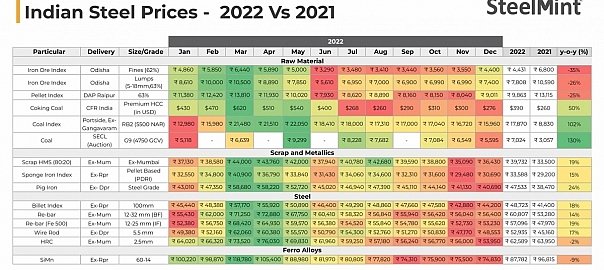
- Thermal coal: Amongst all the steel-related raw materials, imported thermal coal prices saw the highest upturn. Portside ex-Gangavaram prices of 5500 NAR RB2 coal from South Africa rose an astronomical 102% y-o-y to an average almost INR 18,000/tonne (t) against INR 8,830/t last calendar. They touched their all-time high of over INR 22,000/t in May.Russia was the traditional supplier of thermal coal to Europe. However, the western sanctions on the warring nation changed the trade dynamics. Coal-starved Europe turned to sourcing from South Africa as it dusted out its coal-fired power plants amid spiralling gas prices. Naturally, South Africa’s exports to its traditional markets of India and Pakistan dropped, raising prices in the process.
Prices of the popular 5500 NAR escalated post-war. Throughout the year, rampant theft of cables and essential infrastructure in the South African logistics space disrupted supplies. As a result, for cost viability, Indians started importing more of the 4800 NAR. Indian sponge iron players, (biggest user of South African coal) experimented with Russian, Australian, and Mozambique coal blends to offset the steep South African RB2 prices.
- Coking coal: Prices of this fuel showed the second-highest increase of almost 50% to an annual average of $390/t against $260/t last year. Prices hit sky-high in March to $620/t, sobered down to $510/t and $540/t in April and May respectively but almost throughout the year remained above 2021’s average. Actually, prices rising from late last year itself because of supply disruptions due to heavy rains in Australia. However, prices skyrocketed as soon as the war erupted and the West imposed sanctions on Russia. As with thermal coal, so too with coking coal — Europe started sourcing from Australia.
- Iron ore: Prices of fines (62%), lumps (63%) and pellets (63%) dropped by 35%, 26% and 25% respectively y-o-y. Fines ended the year at INR 4,431/t (INR 6,800/t), lumps, at INR 7,808/t (INR 10,590/t) and pellets at INR 9,863/t (INR 13,115/t).The prohibitive export tax on iron ore and pellets had immediately put a brake on overseas dispatches, impacting domestic prices in the process. In a knee-jerk reaction to the duty, output dropped from Odisha – India’s largest iron ore producing state. The 15% export duty on finished steel in May led to intermittent production cuts and lesser lifting of ore which translated into lesser production and impacted iron ore prices.
- Scrap and metallics: Domestic scrap and metallics rose moderately. Domestic HMS (80:20) ex-Mumbai rose 18% to almost INR 40,000/t (INR 33,500/t) amid tightness in local generation and collection thanks to the increased GST drive. The government cracked down on unofficial transaction to bring more players within the GST ambit and increase transparency and tax revenues. As a result, generation and collections became scarce especially in local markets.
- Finished steel: This segment was dealt a body blow by the 15% export duty imposed in May. But, still, prices managed to show a moderate average annual increase only because prices had risen sharply around March-April when Europe had pressed the panic button and procured in large volumes. But prices started going into a free-fall thereafter, losing the support of global and domestic demand, punctuated by the monsoons in-between. Thus, BF-grade rebar ended the year with a 14% increase to INR 60,807/t (INR 53,280/t), and IF-grade, with 19% rise to INR 57,096/t (INR 47,970/t).
HRCs, however, were worse hit, slipping 2% y-o-y to INR 62,589/t (INR 63,950/t) cause of the export tax as easily over 60% of India’s steel exports comprise flats and within this space, HRCs rule.
Leave a Reply